We can help you reduce emissions
Eminox Group of Companies delivers global solutions, from our local European, Indian, North American and UK facilities
Connect with us


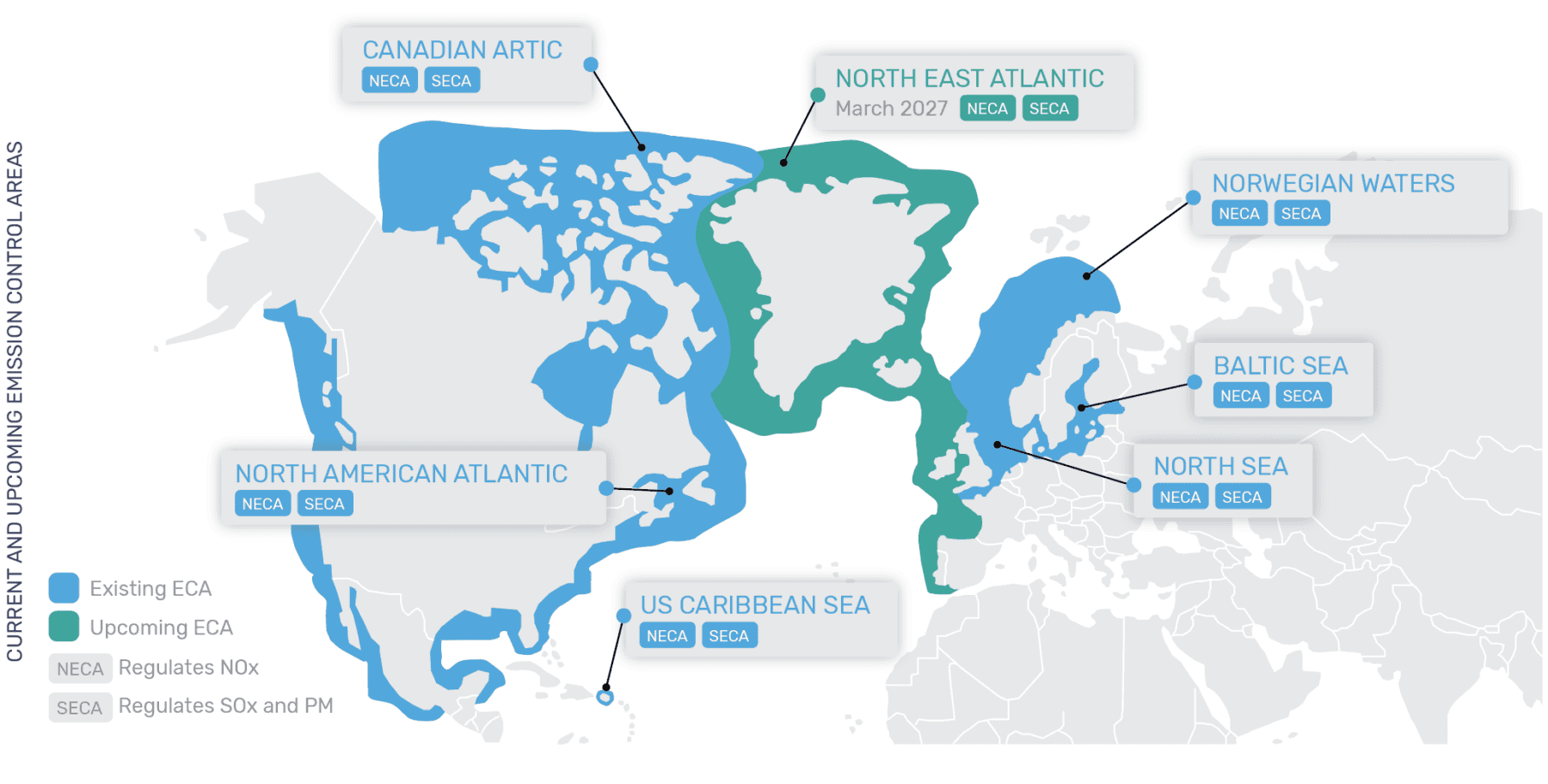
Regulatory tolerance for non-compliance with IMO Tier III NOx limits is narrowing. For vessels above 130kW operating within Emission Control Areas (ECA), covering the North Sea, Baltic, North American coastal waters and beyond, achieving up to 80% NOx reduction against IMO Tier I baselines is now an operational reality, not a future consideration.
The question for commercial workboat operators, boat builders and naval architects, which the Eminox Group of Companies answers in this article is, no longer whether to act, but how to integrate compliant exhaust aftertreatment without compromising vessel performance, stability or project schedules.
Why selective catalytic reduction technology remains the dominant solution
Selective Catalytic Reduction (SCR) is the most technically mature and certifiable route to IMO Tier III compliance. By injecting a urea-based reductant into the exhaust stream, SCR converts nitrogen oxides into nitrogen and water vapour; achieving up to 90% NOx reduction efficiency across a range of operating conditions.
For workboats running variable duty cycles, this matters. Tugs, pilot boats, crew transfer vessels and offshore support vessels rarely operate at steady load; therefore, an aftertreatment system must perform reliably across that complete cycle.
SCR systems, from Emission Control by Eminox can be scaled across engine platforms from 130kW to 5MW, making them applicable across most commercial and defence vessels.
The integration challenge of exhaust aftertreatment systems
The technical case for SCR is well established. The more difficult challenge is installation.
Workboats and defence vessels have tight spatial and weight constraints. Sourcing SCR units, filtration components and control systems from multiple suppliers introduces compatibility risk, complicates commissioning and can create performance inconsistencies that are difficult to diagnose, post-installation.
Retrofit projects add further constraints: limited engine room space, legacy engine compatibility issues and commercial pressure to minimise drydock time.
The most effective approach, whether newbuild or retrofit, is to engage our technical engineers who are experts in aftertreatment. Through the collaboration with Eminox Group engineers, at an early stage, the system modelling and bespoke installation strategies we develop with you will reduce downstream risk and avoid costly redesign.
Preparing for future maritime emissions regulations
IMO and EPA standards are not static. Vessel operators and designers specifying exhaust aftertreatment systems should consider compatibility with hybrid propulsion and alternative fuel configurations too; not as an immediate requirement, but as a design parameter that avoids premature obsolescence.
Integrated aftertreatment systems designed with dual-fuel and hybrid compatibility built in will offer a more durable investment across each vessels operational life.
For technical consultation on SCR integration for new-build or retrofit projects, connect with our Technical Sales Team [email protected]


Eminox Group of Companies delivers global solutions, from our local European, Indian, North American and UK facilities
Connect with us
We design and engineer emission reduction technologies. Our technical expertise and strategic product development enables our customers to achieve their sustainability goals and operational ambitions. We are committed to delivering affordable solutions.
Email: [email protected]
Phone: +44 (0)1427 810088
Eminox Limited, Miller Road, Corringham Road, Industrial Estate, Gainsborough, United Kingdom, DN21 1QB
Eminox Group of Companies





Copyright 2026 Eminox Registered in the UK Registration NO. 01349209 CRT and SCRT are registered trademarks of Johnson Matthey plc.